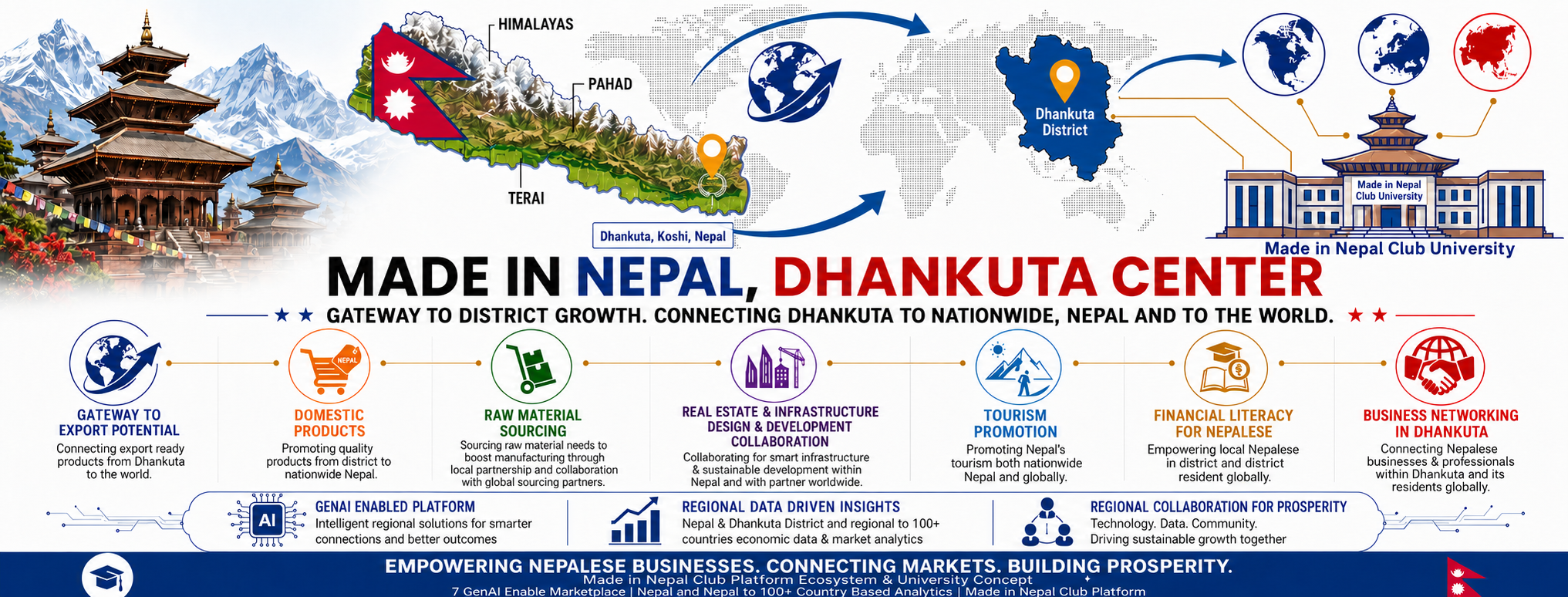
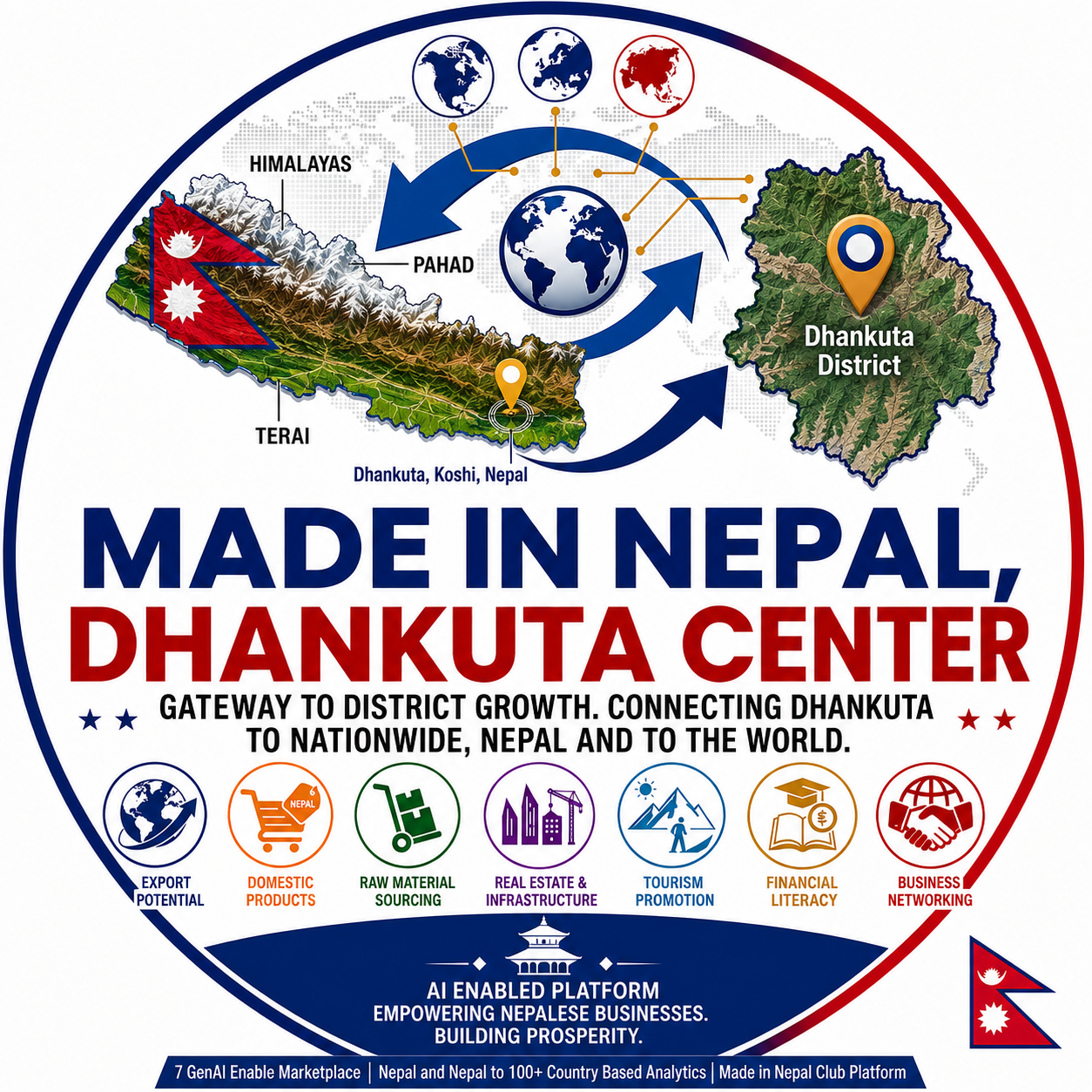
Gateway to Growth. Connecting Dhankuta to Nepal and the World.
VisitDhankuta.com | International + Nepal Business Strategy Brief
Dhankuta Economic Gateway
Building a District-to-Nepal-to-World ecosystem for export potential,
domestic products, technology sourcing, infrastructure, tourism,
financial capability and business networks.
Strategic Research BriefSeptember 2026Dhankuta District, Koshi Province, Nepal
Gateway to Export Potential • Domestic Product Promotion •
Raw Material Sourcing • Real Estate & Infrastructure Design &
Development Collaboration • Tourism Promotion • Financial Literacy
for Nepalese • Business Networking in Dhankuta, Nepal and to the World
A District Economy With Three Connected Markets
Dhankuta had 150,599 residents in Nepal's 2021 census
and is organized into 7 local governments - three
municipalities and four rural municipalities. A Koshi Province
district profile records an area of about 892 km².
Dhankuta should not be treated as a stand-alone local market.
The Center should connect district production and services
with nationwide Nepal distribution, finance and institutions,
and then with global buyers, tourists, technologies and diaspora.
The district has unusual economic assets for a hill economy:
nationally important citrus research at Paripatle, a long-established
agricultural research station at Pakhribas, established fruit and
vegetable production, and tourism nodes such as Hile, Bhedetar,
Namaste Falls, Mulghat and Dhankuta Bazaar.
150,599District population | 2021
7Local governments
9,592Residents absent abroad | 2021
892 km²District area
Seven Integrated Global Platforms
Every Feasibility Study Must Work at District, Nepal and Global Levels
Each platform should evaluate who benefits inside Dhankuta, how the
opportunity scales through Nepal, and where global buyers, investors,
tourists, technology providers or diaspora can add value.
1. Dhankuta District Businesses
2. Nationwide Nepal Market & Institutions
3. Global Buyers / Partners / Diaspora
1
Gateway to Export Potential
Start with products that have a credible Dhankuta identity or
production base: Khoku mandarin and other citrus, avocado, tea,
chhurpi/dairy, Dhaka textile products, bamboo craft, vegetables,
spices and selected processed foods. Export feasibility should test
aggregation, grading, cold chain, packaging, traceability, HS codes,
certification, logistics and buyer economics before promotion.
Commercial evidence: a national fruit-origin/GI study
reports annual income among some Dhankuta mandarin farmers of
Nrs 400,000-2,000,000 (approx. USD 2,646-13,229),
depending on orchard size. USD equivalents use the 7 September 2026
Nepal Rastra Bank reference midpoint of Nrs 151.18 per USD 1.
District: farmers, cooperatives, processors, artisans and youth enterprises. Nepal: wholesalers, retailers, hotels, food processors and exporters. Global: importers, specialty retailers, ethnic/diaspora markets and distributors.
Market Research and Feasibility Study On:Gateway to Export Potential - Dhankuta to Nepal and the WorldView Market Research→
2
Domestic Product Promotion
Build a recognizable Made in Dhankuta identity around
origin, agricultural quality, hill craftsmanship and cultural authenticity.
Producer directories, professional photography, QR-based product stories,
retail packaging, Hile/Dhankuta Bazaar showcases, provincial fairs and
social commerce can turn fragmented production into a visible market system.
District: producers, bazaars, cooperatives and municipal promotion. Nepal: Dharan, Biratnagar, Itahari, Kathmandu and national e-commerce/hospitality markets. Global: diaspora events, multilingual digital promotion, trade fairs and specialty retail.
Market Research and Feasibility Study On:Domestic Product Promotion - Made in DhankutaView Market Research→
3
Raw Material & Technology Sourcing
Dhankuta businesses need better production inputs as much as they need buyers.
Feasibility studies should examine disease-free citrus and fruit planting material,
irrigation, protected cultivation, cold storage, grading and packing, food-processing,
dairy equipment, solar systems, digital tools and small-scale manufacturing technology.
Pakhribas Agricultural Research Station and the National Citrus Research Program can
serve as technical knowledge anchors.
District: higher yields, lower losses and improved product consistency. Nepal: supplier links, research institutions and local technology service providers. Global: verified suppliers, licensing and technical partnerships only where lifecycle economics justify import.
Market Research and Feasibility Study On:Raw Material & Technology Sourcing for Dhankuta EnterpriseView Market Research→
4
Real Estate & Infrastructure Design & Development Collaboration
Dhankuta Municipality's resilience planning identifies irrigation, storage,
transport and climate-related agricultural constraints. Productive investment
should therefore prioritize collection centers, cold rooms, agro-processing,
market sheds, workshops, tourism lodges, water systems, broadband, resilient
buildings and logistics nodes rather than stand-alone real estate speculation.
District: farmers, MSMEs, municipalities, tourism operators and residents. Nepal: developers, architects, engineers, banks, operators and investors. Global: diaspora capital and technical partners where project-level feasibility supports investment.
Market Research and Feasibility Study On:Real Estate & Infrastructure Design & Development CollaborationView Market Research→
5
Tourism Promotion - Visit Dhankuta
Build bookable circuits around Bhedetar/Charles Point, Namaste Falls,
Hile, Dhankuta Bazaar, Mulghat and the Tamor corridor, Chuliban, community
homestays, tea/citrus landscapes and Athpahariya/Kirat culture.
Nepal Tourism Board specifically promotes Dhankuta's relaxed hill scenery,
local produce, homestays and Bhedetar/Namaste Falls experiences.
District: hotels, homestays, guides, transport, food, farms and craft sellers. Nepal: weekend travelers, eastern-Nepal circuits, schools, corporate retreats and domestic tour operators. Global: diaspora visitors, cultural travelers, nature/soft-adventure travelers and responsible-tourism markets.
Market Research and Feasibility Study On:Tourism Promotion - Dhankuta to Nepal and the WorldView Market Research→
6
Financial Literacy for Nepalese
Serve farmers, cooperatives, youth, MSMEs and migrant families with education on
budgeting, bookkeeping, productive credit, insurance, digital payments, savings,
taxation awareness, remittance planning, foreign-exchange awareness and investment
fundamentals. With 9,592 Dhankuta residents recorded abroad in 2021, financial
literacy should also support returnee enterprises and productive diaspora reinvestment.
District: stronger household and enterprise resilience. Nepal: improved formal banking, credit readiness and MSME management. Global: migrant/diaspora households, remittance planning, FX awareness and credible investment pathways.
Market Research and Feasibility Study On:Financial Literacy for Nepalese - Dhankuta Families, Entrepreneurs & DiasporaView Market Research→
7
Business Networking in Dhankuta, Nepal and to the World
This platform should become the connective infrastructure for the other six.
Build verified directories of farmers, cooperatives, processors, tourism businesses,
professionals, contractors, investors and institutions; match them with Nepal-wide
buyers, finance and technical partners; and map Dhankuta-origin diaspora, importers,
mentors, investors, tourism promoters and technology providers globally.
District: trusted discovery, referrals, supplier and buyer matching. Nepal: B2B access, banks, institutions, universities, retailers and exporters. Global: diaspora mentorship, buyer introductions, tourism promotion, technology partnerships and deal flow.
Market Research and Feasibility Study On:Business Networking in Dhankuta, Nepal and to the WorldView Market Research→
The Strategic Business Window
Research -> Production -> Value Addition -> Nepal -> World
Dhankuta has a stronger-than-average innovation base for a Nepali hill district.
The Agricultural Research Station at Pakhribas has served the eastern hill region
for decades, while the National Citrus Research Program at Paripatle carries a
national mandate for citrus technology. The business opportunity is to connect
research institutions more directly with commercial farms, processors, packaging,
cold chain, branding and market development.
Dhankuta Municipality's 2024 resilience roadmap reports agriculture as the primary
income source for more than 60% of its population, identifies avocado as a trademark
fruit, and notes storage, irrigation, transport and climate pressures. This makes
post-harvest systems and resilient production more important than simply expanding acreage.
Tourism adds a second export channel. Bhedetar, Hile, Namaste Falls, Dhankuta Bazaar,
Mulghat, homestays and agricultural landscapes allow the district to sell experiences
as well as products. Diaspora and digital platforms provide the third connection:
people who have left Dhankuta can become customers, mentors, investors and market builders.
International + Nepal Business Strategy
VisitDhankuta.com should not operate as a tourism-only portal. It can function as an
integrated district economic gateway connecting production, branding, technology,
infrastructure, tourism, financial capability and business networks under one system.
LOCAL VALUE CREATION + NATIONWIDE DISTRIBUTION + GLOBAL MARKET ACCESS +
AGRI-TECH + TOURISM + DIASPORA CAPITAL + B2B NETWORKS
Turning Dhankuta's Identity Into Measurable Economic Opportunity
VisitDhankuta.com / Made in Nepal, Dhankuta Center can become
a practical economic gateway connecting Dhankuta's farmers, processors, tourism
communities, youth and entrepreneurs with Nepal's domestic markets and with global
buyers, visitors, investors, diaspora and technology partners.
Currency & Research Note:
Where a monetary figure is shown, both Nrs and USD are provided. USD equivalents are
indicative and rounded using the Nepal Rastra Bank midpoint of
Nrs 151.18 per USD 1 on 7 September 2026, calculated from the published
buy rate of Nrs 150.88 and sell rate of Nrs 151.48. Actual bank and transaction rates vary.
This page is intended for general district economic-development, trade, tourism,
infrastructure and financial-education information only. It does not constitute legal,
tax, engineering, customs, investment or regulated financial advice. Each project,
export product and investment should undergo current technical, market, regulatory
and financial feasibility review.
Research Published by Jay Sarraf, USA, Currently in Kathmandu,Nepal
, Supported by The Raj Sarraf, USA